
Showing posts with label pavilions. Show all posts
Showing posts with label pavilions. Show all posts
Saturday, August 02, 2008
Russian pavilion: deepest lake in the world and more

Monday, July 14, 2008
Back to the future: return to EDO

Monday, June 16, 2008
3 days to go, 1 minute to see and 2 years to build...without LEGO
Wednesday, February 06, 2008
Belgium at Expo Zaragoza 2008

The country is also divided in terms of water resources, with the North dependent from the South. Wallonia satisfies 55% of the national needs in drinking water when it counts only 37% of the population. Flanders and Brussels are not self-sufficient. The positive side is that Belgium people have mastered dialogue and consensus building, learning to live with multiple decision making centers...
In addition to the exhibit project of the Belgium pavilion , I can positively advise not to miss this pavilion for a number of other reasons, including to taste a good Belgium beer...I would give a try to Duvel, for example...to provide the right environment for such endeavor, the Belgium commissioner´s office will install and manage a Belgium café that will be also used as a platform for Belgium artists performing there.
Talking about art, not to miss the expo from Jan Fabre at the Belgium pavilion. See above the man writing on water, an installation made up of seven bronze bathtubs where there is a sculpture-portrait of the artist seated in the second one, in the process of writing on the water with his finger...
Monday, October 29, 2007
Japanese sustainable civilization shows wisdom at Expo Zaragoza
The above explains why “Harmony with Water, Wisdom and Skills” is the theme for the Japanese pavilion at Expo Zaragoza 2008.

I think is a cool theme. Honestly, I think we all have a lot to learn from Japan, especially taking into account they previous Experience in Expo 2005 in Aichi under the them of ”Nature’s wisdom”.
In addition to help us to understand the Japanese philosophy from the EDO period , to enter the Japanese pavilion will also be an opportunity to see first hand cutting-edge technologies that help to solve global-scale tasks. Enjoy!
In addition to help us to understand the Japanese philosophy from the EDO period , to enter the Japanese pavilion will also be an opportunity to see first hand cutting-edge technologies that help to solve global-scale tasks. Enjoy!
Wednesday, July 11, 2007
“Acciona”, saulty water and Expo Zaragoza 2008
Acciona is a multinational working, among others, in the field of water
desalination. They are also official partners of Expo Zaragoza 2008 (in fact they will exhibit in a huge 1000 m2 pavilion) and they use this fact for their ads in newspapers.

Specifically Acciona will sponsor with 8 million euros (partially deductible). Acciona itself has been granted several projects within the Expo, including pavilions and other major infrastructures.
Coming back to the ads of Acciona, above you can see -next to the Expo Zaragoza logo- an example of their vision of a better tomorrow. They say: this year, we will build in California the biggest desalination plant in the USA, with a capacity of 204.000 cubic metres per day. Wouwww! This is a lot of water for thirsty people…. looking in the info of a previous post we could debate if they drink too much: Zaragoza consumes 100 litres per inhanbitant per day…Los Angeles 400 Litres…. Rwanda has an average water consumption of 10 litres per person per day...
What the advertisement doesn’t say is that to take the salt out of the water you need a lot (but a lot) of electricity, ie. a lot of potential CO2 emissions…and it could, because Acciona is also working on renewables....
In Spain a plan (called Agua) was presented to build plants to produce 600 millon of cubic metres of water per year. This is a lot of CO2 emissions if fossil energy is used to fuel them
If Spain is to comply with Kyoto targets, will need to plug all this new plants to non-fossil sources such as solar, wind, etc. We will see...probably a fantastic debate (sponsored by Acciona ;) to take place at the Expo Acciona pavilion next year.
Tuesday, June 12, 2007
Oikos outdoor pavilion at Expo Zaragoza 2008
O-ikos means “the house” in Greek. Situated in the Ebro plaza, near the river aquarium the “Oikos”: Water and Energy Plaza” will showcase different sources of energy and devices to capture it such as solar panels, windmills, etc:

-The Sun. in a 6-metre diameter room with a dome-shaped roof the Sun is presented as the cause of meteorological phenomena, the day, night and our seasons.
-The wind. The visitor learns about the origins and characteristics of this meteorological phenomenon using three great tubes which, coming from the bottom with cold air, go through a module culminating in three chimneys. Surrounding the tubes there is a spinning hoop that represents a mill in motion.
-The house and water. The installation explains the importance of hydroelectric power using a mechanism composed of wind pump that extracts water from a well. This falls like rain on a dam, whose water then goes through a turbine to generate electricity. Finally it goes into an installation like a home where there visitor can see the many applications of water in the house.
-Climate control. The public goes through two “chambers”, one cold and the other hot, to point out the importance of insulation as a fundamental aspect of good climate control. If you want to know more on how you control climate change click at LINK
Lastly, in the final module, with the title “The possible house”, the application of all the alternative techniques viewed throughout the plaza is shown to reduce consumption of fossil fuels.
The above themes are very much in line with Aragon renewables potentialities. According to a GreenPeace report Aragon's solar potential would make it possible by 2050 to meet thirty-two times the projected total energy demand for this Community in 2050 (47.2TWh/year) and its wind potential would generate 5 times demand.
The pavilion itself has an exposition surface of 845 m2 and a budget of 3,4 million euros. Authors are Domingo Guinea, from CSIC as technical adviser and the german Roland Olbeter, who is an engineer by training and an artist (see his curious fontain in a previous post) who worked, among others, in the inauguration ceremony of the Olimpic Games of Barcelona 1992.
Thursday, May 31, 2007
Chinese water culture exhibited at the 2008 Zaragoza World Expo
The winning bid has been designed by the Chinese Academy of Social Sciences and Beijing Zhongjian Architect Ltd.

One of the main themes of the Chinese hall will be to exhibit water control achievements including the Chinese three gorges dam. This will probably be a topic in the Extreme Water Pavilion from the point of view of the power of water.
I have to say that the term of “developing country” might be not give the whole picture of a country such as China. I leave you with the wikipedia definition of a developing country a developing country has a relatively low standard of living, an underdeveloped industrial base, and a moderate to low human development index (HDI) score.…
Pd. The photo above is the only graphic material i could find on the Chinese exhibition hall at Expo Zaragoza 2008. If you have more info & photos please let me know.
Pd. The photo above is the only graphic material i could find on the Chinese exhibition hall at Expo Zaragoza 2008. If you have more info & photos please let me know.
Monday, May 07, 2007
La “Cesta”: Aragon’s pavilion at Expo Zaragoza 2008
With a surface of more than 47.500 Km2 Aragon is larger than other European countries such as Denmark, Holland or Switzerland and… of course, much less known than them.

As I believe this to be a pity, I will use another post (or a lot of them, in fact) to let you know what you might be missing....
In this blog, I will concentrate on the Aragon’s pavilion (see above). It is quite curious that in a previous post I explained to you the curious shape of the Citizen’s initiative pavilion known as “el botijo” and now I have to explain another traditional pavilion: “la cesta”.
 What’s a “cesta”? A basket. An how are they made? According to wikipedia the process consists on weaving unspun vegetable fibers together. 1 image is worth 1000 words so look on your left to see a basket being woven. Seems quite relaxing...
Pd. If you cannot wait to know more about Aragon, note that at the Aichi exhibition Aragon organized (within the Spanish Pavilion) an events week, with different activities which included Calanda drums and dancing performances.
What are Calanda drums? Here you are:
http://www.expo2005.or.jp/en/nations/release/pdf/050706_spain.pdf
Enjoy!
Wednesday, April 11, 2007
Expo Zaragoza 2008 features extravagant "Botijo" building
It is also the nickname of the Citizens’ Initiatives Pavilion building that NGOs such as WWF, Red Cross, Oxfam, etc are preparing for the Expo Zaragoza in 2008.
Ricardo Higueras, the architect responsible for the pavilion explains that domes are very old. In this case it is a concentric dome. The shape chosen comes from the ceramic water jug, from which it takes the temperature
 regulation system. Have you ever been in a building made of mud?
The building (see above) has a budget of 1.8 million euros...quite expensive for a mud building...is designed to last for three months as it is in a floodable zone...nothing is eternal…
Pd. According to Aminata Traore co-founder of the Social Africa Forum is fake than in Africa there is no water. Water exits and if it is being said that is a scarce resource in Africa is because (they) want to sell it...
Friday, February 23, 2007
African pavilion in Expo Zaragoza 2008
This 7 metres high façade will be the entrance of the Sub-Saharan Africa pavilion at night. It plans to show beautiful, evocative images of "steppes, grasslands and savannas", the theme of the pavilion.

A company called Nussli, is in charge of the pavilion and his Director Daniel Cordey, thinks that this façade will " really create the impression of being in Africa”...and once inside? Each country zone is divided into three areas: city, countryside and water. The urban area, themed around cities and culture, is always on the outside edge of the pavilion and provides an enclosed area for individual events. The countryside area focuses on the themes of agriculture, food and natural resources. And the water….
...the water falls from the sky...well not really…from the ceiling of the pavilion. Once there, look up and you will see several screens in the shape of clouds. According to Daniel, by the time the show starts, the clouds have already begun to perform and they will act as a kind of guide to help gathering people around...cool!
If you want to know more about those countries & other African countries, I recommend you to go to the previous Aichi Expo in 2005 under the them of ”Nature’s wisdom”. You just need to click on the African pavilion website and will see on the right hand side a handful of African flags. Click any of them to find the expectations of the Presidents of those countries, photos of their breathtaking landscapes and much much more….
Tuesday, January 23, 2007
Expo Zaragoza 2008 Bridge Pavilion and its (arguable) predecessor
Zaha Hadid is an architect who experiments with new concepts in the pursuit of something new and appealing. For Zaragoza itself, to experiment with multifunctional bridges is not totally new as seen in the left of the picture which shows Zaragoza and its peculiar -and somehow old- bridge; picture is from 1647…almost 4 centuries ago!.

Just starting the XXI century Ms. Hadid seems to have the intention to create a magnificent gladiolus shape. Clearly, this organic approach nominally fits with the Expo Zaragoza 2008 theme of "Water and Sustainable Development". Sure it does, but not only nominally….as it is expected that the ¨skin¨of this pavilion will create a natural air-conditioning .... to start with: Bravo! . I will keep an eye on to see whether i can gather more specific information on this somehow "living" building...
Friday, December 15, 2006
Ebro bridge-pavilion at the 2008 International Expo in Zaragoza gets world class content providers
…well, we won’t have the USA as official participants to our Expo in Zaragoza, but we will enjoy American creativity from the hands of the Ralph Appelbaum Associates. They have won the € 928,000 contract to design the contents of the bridge pavilion at the 2008 International Expo in Zaragoza.
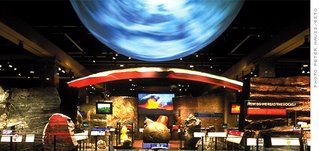
These guys have done wonderful things in the past. For instance, New York’s Museum of Natural History (see photo above of "Hall of Planet Earth") and –closer to Spaniards & Europeans- the contents of the science pavilion at the City of Arts and Sciences in Valencia http://www.cac.es/home?languageId=1
I wish all the best inspiration for their team!!
NB: BTW, they will probably work for the World Exposition Shanghai China 2010. For the time being, they are included in the list of the First Batch of Recommended Service Providers for the World China Expo under the heading of Exhibition Planning and Designing.
(http://www.expo2010china.com/expo/expoenglish/bulletin/userobject1ai38251.html)
Monday, October 23, 2006
Extreme Water pavilion (II)
 or New Orleans".
I hope that the pavilion wont be a excuse for massive bombardment of the public with fears on natural catastrophes. I think this pavilion should deal with information and awareness but without creating any anxiety to the visitors. After all, we all know there are dangers that, although improbable, once they happen they can have devastating effects.
But if the pavilion is going into that fearful direction, what about to tackle the Three gorges dam in China (see right) and, for example, go into explaining what are the contingency plans in case there is an earthquake there….
The Chinese are attending the Expo Zaragoza 2008, among other reasons because they will be hosting the Expo 2010 Shanghai China (http://www.expo2010china.com/expo/expoenglish/index.html). So, for sure the Chinese Three gorges dam will become a potent symbol in their pavilion. Thus, it might be good for the visitors to see the other side of the coin…either in the Chinese Pavillion or in the Extreme Water one? Anyone knows what will be featured by the Chinese on the Zaragoza Expo 2008?
See more information on the Extreme Water pavillion at:
http://expo-zaragoza-2008.blogspot.com/2006/10/expo-2008-extreme-water-pavillion.html
Monday, October 09, 2006
Expo 2008: “Extreme Water” pavillion
 The 22 metres high pavilion construction should start by March 2007. According to the designers this pavilion will show the devastating effects of natural disasters : Tsunamis, etc. From outside the building will have the shape of a Tsunami wave …once inside you will be put the safety belt and will start feeling the power of water…
Monday, September 11, 2006
Welcome to Expo Zaragoza 2008 blog!
 Zaragoza has been selected to host the International Exhibition in 2008 (from 14th June to 14th September 2008) under the Theme “Water and Sustainable Development”. Zaragoza is my city and I feel very proud of it. Currently, I am working in Belgium on environmental issues so the Expo theme is very much of my interest.
When talking with non-spanish friends they are asking me all kind of questions regarding the Expo in Zaragoza. So I have decided to blog the some of the info I am providing my friends with.
In addition, while at work I meet with many foreigners. So far, when I talk with them about Zaragoza they usually are unable to put it ”on the map” often mentioning either Vasque Country or Catalunya as the region where Zaragoza is located. When I then mention Aragon it rings some bells but not that many…
But enough about myself. Let´s talk about the rules of the blog. Every now and then (ideally every month) I will be posting on different issues related to the Zaragoza Expo 2008 (see below some examples in not particular order) and I would do my best that debate grows around them, so the information flows smoothly from both sides of this blog.
Budget trip to the Expo & around from how to buy promotional entry tickets to which companies to flight in at low rates. And for those with extra holidays, you might want to know that Zaragoza is in a junction just around 1 hour from Madrid or Barcelona by high speed train or 3 hours drive from Bilbao or Valencia.
Virtual Expo for those who cannot come…or those who cannot wait, I will do my best to grant you all available resources for a virtual visit to the Zaragoza Expo 2008. To start with, you can already have a virtual “eagle view” of the Expo at http://www.expozaragoza2008.es/en/proyecto/proyecto.htm
Expo ceremonies & regional days, there are a lot of singular traditions in Spain and many regional days take place during summer. For example, in Aragon there are different ways of having “fiesta” and one of them involves a cow… and although some might think is not as artistic as the cow pictured here...
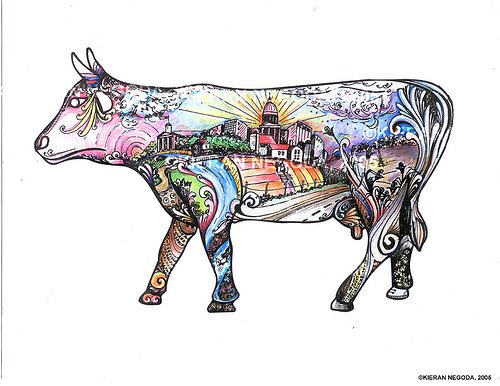
but it might be artistic in its own way….
Bridge Pavillion, this pavilion Bridge will pass obliquely over the River Ebro and its cross-section will be diamond-shaped. Hard to imagine? Well, this is the way Zaha Hadid is (http://www.zaha-hadid.com/ and see...

...a previous work by her in which something originally planned as a fire station, became a museum.
Post-Expo Zaragoza 2008 will be another topic to deal with. I visited the Dutch pavilion in the Hannover Expo in 2000 with a German friend and it was great. Sadly enough, if you can go now at http://www.dutchpavilion.nl/exponu/index.htm scroll down, you will see the struggles of time.
Waterscapes, being Water the main theme of the Expo I will post the diverse water & landscapes of Zaragoza and surroundings...that should be a good basis to discuss with you the influence of the Zaragoza Expo 2008 in the sustainability debate which is more a more at the center of international conferences. I leave you with Kiccoro (Forest Child ) and Morizo (Forest Grand Father) mascots for Aichi Exhibition and Fluvi (river of life), the Zaragoza expo mascot...

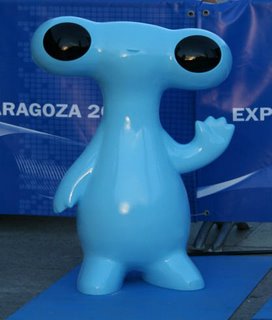
Greetings to all readers
Subscribe to:
Posts (Atom)


